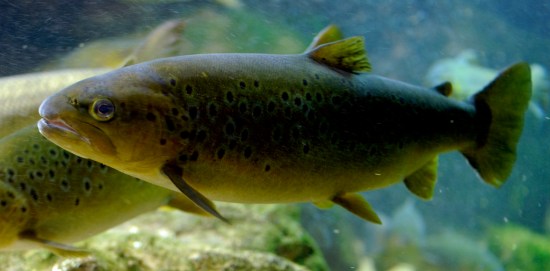
 In my last post, I wrote about whether we can imagine experiencing a sense that we don’t possess (such as a trout’s sense of magnetic fields). Since then a study has come out that adds a new twist to our little thought experiment. And for that we can thank six trailblazing rats in North Carolina.
Like us, rats see only a sliver of the full electromagnetic spectrum. They can perceive red light with wavelengths as long as about 650 nanometers, but radiation with longer wavelengths (known as infrared, or IR, radiation) is invisible to them. Or it was before a group of researchers at Duke began their experiment. They first trained the rats to indicate with a nose poke where they saw a visible light turned on. Then the researchers mounted an IR detector to each rat’s head and surgically implanted tiny electrodes into the part of its brain that processes tactile sensations from its whiskers.
After these sci-fi surgeries, each rat was trained to do the same light detection task again – only this time it had to detect infrared instead of visible light. Whenever the IR detectors on the animal’s head picked up IR radiation, the electrodes stimulated the tactile whisker-responsive area of its brain. So while the rat’s eyes could not detect the IR lights, a part of its brain was still receiving information about them.
Could they do the new task? Not very well at first. But within a month, these adult rats learned to do the IR detection task quite well. They even developed new strategies to accomplish their new task; as these videos show, they learned to sweep their heads back and forth to detect and localize the infrared sources.
Overall, this study shows us that the adult brain is capable of acquiring a new or expanded sense. But it doesn’t tell us how the rats experienced this new sense. Two details from the study suggest that the rats experienced IR radiation as a tactile sensation. First, the post-surgical rats scratched at their faces when first exposed to IR radiation, just as they might if they initially interpreted the IR-related brain activity as something brushing against their whiskers. Second, when the scientists studied the activity of the touch neurons receiving IR-linked stimulation after extensive IR training, they found that the majority responded to both touch and infrared light. At least to some degree, the senses of touch and of infrared vision were integrated within the individual neurons themselves.
In my last post, I found that I was only able to imagine magnetosensation by analogy to my sense of touch. Using some fancy technology, the scientists at Duke were able to turn this exercise in imagination into a reality. The rats were truly able to experience a new sense by piggybacking on an existing sense. The findings demonstrate the remarkable plasticity of the adult brain – a comforting thought as we all barrel toward our later years – but they also provide us with a glimpse of future possibilities. Someday we might be able to follow up on our thought experiment with an actual experiment. With a little brain surgery, we may someday be able to ‘see’ infrared or ultraviolet light. Or we might just hook ourselves up to a magnificent compass and have a taste (or feel or smell or sight or sound) of magnetosensation after all.
____
Photo credit: Novartis AG

Thomson EE, Carra R, & Nicolelis MA (2013). Perceiving invisible light through a somatosensory cortical prosthesis. Nature communications, 4 PMID: 23403583
 Most of the time I forget that my mother lacks a sense of smell. It’s only when I complain about something stinky or comment on a delicious smell that I remember she isn’t sharing the experience with me. As I’ve mentioned
  Garden of the Mind