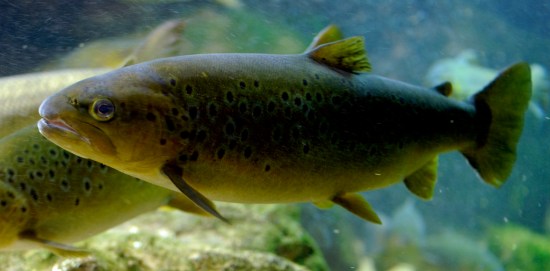
Be the Trout

1448187231_be85e17541_bMost of the time I forget that my mother lacks a sense of smell. It’s only when I complain about something stinky or comment on a delicious smell that I remember she isn’t sharing the experience with me. As I’ve mentioned before, my mother has never had a sense of smell, or at least none that she can ever remember. As a child, I often wondered how she might imagine the sensation of smell. Would she do it by analogy to her other senses? Would she be able to do it at all?

I returned to these musings from a different perspective recently when I read a scientific paper about trout. Trout, along with other migratory species from salmon to sea turtles and certain types of birds, enjoy a sense that we lack: magnetosensation. These animals perceive magnetic fields (including that of the Earth) and can use this information to orient themselves and navigate. The study’s authors found magnetic cells inside the noses of trout, each with tiny iron-containing crystals attached to their cell membranes. Thus, when a trout changed direction relative to the Earth’s magnetic field, these miniature magnets would presumably tug on the cell’s membrane in a way that the cell could detect and signal to other parts of the trout’s nervous system. The evolution of these wonderful little biological compasses may have been necessary for migrating animals to evolve on our planet and happily roam, return, and repeat.

So today I put myself in my mother’s shoes (or nose) and tried to imagine a sense I didn’t have. What would it be like to feel magnetic fields? I tried to embrace the role and be the trout. I closed my eyes and imagined my little trout self swimming around within a magnetic field that changed as I moved. How would that feel for the trout? My imaginative efforts were rewarded with a strong percept – flashes of tingling across the surface of my skin that mirrored my changes in direction. In essence, I could only imagine magnetosensation by analogy to somatosensation, the sense of touch. And this is almost certainly not what magnetosensation feels like to a trout. Not only do they already have a sense of touch akin to our own, but they also detect magnetic fields with their snout rather than their whole body.

It makes sense that I imagined a foreign sensation by analogy to one I know. Each of our senses has dedicated processing areas in the brain. Without a brain area developed for magnetosensation, it may not be possible to do any better than imagine it by way of the senses our brain can process. Or maybe it’s possible for people with more imaginative imaginations than my own. If you give it a try, please let me know what you come up with! And the next time you find yourself staring down a trout, tilapia, tuna, or salmon on your plate, spare a moment to appreciate that it has experienced a realm of sensations beyond your imagination. And then – bon appétit!

___

Photo credit: sharkbait

ResearchBlogging.org

Eder SHK, Cadiou H, Muhamad A, McNaughton PA, Kirschvink JL, & Winklhofer M (2012). Magnetic characterization of isolated candidate vertebrate magnetoreceptor cells PNAS DOI: 10.1073/pnas.1205653109

At the Gates of Sleep

497736998_45c09a136e_oNow that my daughter is about to reach her first birthday, I’m in the mood to reflect on the year that just passed. Unfortunately, my recollections of it are a little fuzzy, probably because I can count on one hand the number of times I’ve enjoyed a good night’s sleep over the past year. Some people have babies who regularly sleep through the night and I am happy for them. Truly, I am. But clearly I was not meant to be in their ranks.

Still, the never-ending parade of nighttime awakenings has taught me something about my own brain. It is precisely tuned to hear my baby. Although I sleep blithely through my husband’s thunderous snoring and the loud buzz of his alarm clock – multiple times a day, thanks to the snooze button – I awaken at the faintest sound of my daughter’s sighs, coos, or grumbles. When she cries, I am immediately awake while my husband sleeps on beside me, undisturbed.

People are generally able to sleep through minor sounds and sensations thanks to a subcortical structure in the brain called the thalamus. This structure receives incoming signals from our senses and relays them to cortical areas devoted to processing sensory information like sounds or tactile sensations. When we’re awake, the thalamus faithfully relays nearly every sensory signal on to the cortex. But when we’re asleep, neurons in the thalamus participate in strong, synchronized waves of activity that squelch incoming signals. As a result, about 70% of these signals never make it to the cortex. This process, known as sensory-gating, is how we manage to sleep through the roar of rainstorms or the brush of the sheets against our skin each time we turn in bed. It is also how we sleep through our husband’s room-rattling snores.

Yet some sensory information does get through to the rest of the brain during sleep. These signals do get processed and can even wake us up if they are either intense (like a loud noise) or personally relevant. A clever study illustrated the importance of personal relevance by exposing sleeping subjects to a loud presentation (via tape recorder) of their own name spoken aloud. The scientists played the recording either normally or backwards and found that subjects awoke in less than half the time when they heard their names presented in the recognizable form.

So did my daughter, in effect, sleep train me by training my brain to recognize her sounds as personally relevant? It’s a plausible explanation, but one that is ultimately lacking. It cannot explain that first night when I slept beside my baby at the hospital nearly one year ago. Although I had labored through the entire night before and had not slept in the ensuing day, I awoke constantly to every little sound my mewing newborn made, not to mention the cries that told me she wanted to nurse. She’d had no time to train me; I had come pre-trained. Just as my breasts were primed to make milk for her, my brain was primed to wake for her. We seemed to be engineered for one other, mother and child, body and brain. And we spent that first long night discovering how clever a designer Nature can be, while my husband slept peacefully on the couch.

___

Photo credit: planetchopstick

Sandy, Science, and a New Campaign

As Tuesday’s election approaches and news coverage of super storm Sandy recedes, I’m struck by the absurdity of our current situation. While cities on the East Coast are still pumping water out of tunnels and salvaging belongings from ruined homes, we get back to talking about the economy. That and reproductive rights.

Yet we are surrounded by evidence of climate change, even beyond our recent run-ins with Sandy and Irene. We have seen increases in the frequency and severity of storms, droughts, and wildfires. Already, drought has affected food prices here in the U.S. and caused widespread famine in Africa. Massive ice shelves in Antarctica are melting and crumbling into the sea, demonstrably raising sea levels worldwide. And this past year brought us record-breaking temperatures, one after another, as we watched a freakishly warm winter give way to a sweltering summer.

Despite the mountain of scientific evidence that climate change is real and ample demonstrations of the devastation it can wreak, the topic has not been an issue in this year’s presidential election. It wasn’t discussed in any of the three presidential debates. This is not an oversight on the part of the candidates and the moderators. Americans are simply not worried about climate change. In a Gallup poll from September, only 2% of respondents ranked environmental issues as the most important problem facing our country today. Most ranked unemployment and our lagging economy as the nation’s greatest woe.

While people are certainly suffering in today’s economy, the dismissal of climate change is terribly shortsighted. Climate change is an economic threat. It has already raised (and will probably continue to raise) the cost of food. We have also faced steep costs as a result of extreme weather. New York State’s economy alone lost as much as 18 billion dollars due to Sandy and fortifying New York from future flooding could cost upwards of 20 billion dollars. Those figures don’t include the damage in other states and they don’t include the expense to homeowners who are rebuilding or who will try to insure their homes in the wake of this storm. And of course it can’t include the personal devastation and loss of life.

So why aren’t we talking more about climate change? And why aren’t we doing more, both in our own lives and in our voting choices, to try to stem the tide?

It seems to me that we are witnessing a human psychology experiment on the grandest scale. How can we ignore (and in fact perpetuate) an impending disaster of such magnitude? In fact, humans have quite a bit of practice at ignoring future doom. After all, we live out our lives with the certainty that we will die and we function in large part by not thinking about it. Death? What death? Climate change? What change?

I wrote before about how our disappearing glaciers may be suffering from a PR problem. They need a spokesman or a mascot – something that might tug at our heartstrings and make people care. Now I think we need a similar approach for climate change itself. The climatologists have done their job and demonstrated that climate change is real. But our first and greatest obstacle in fixing it may lie within ourselves or, more specifically, our skulls.

I think it’s time to call in the psychologists, the marketing specialists and the public relations gurus. Through years of research, we already know the many ways that human beings are illogical and we know how to persuade and manipulate them. Beer has bikini-clad women. Cigarettes have cowboys. Viagra and Cialis have politicians and quarterbacks. Why can’t we do the same for our planet? It’s time we held focus groups and raised ad dollars. It’s time for a climate campaign.

Popular opinion has always driven political will. We need to use every resource we have to raise awareness and change minds. So let’s bring in the psychologists. Let’s bring in the bikini-clad women if need be. (After all, it’s going to be hot!) But before we can influence others, we have to begin by changing ourselves. By changing our lifestyles. By changing our priorities. By changing our minds and then voting our minds. And there’s no better time to start than this Tuesday.

I’ll see you at the ballot box!

Tooling Around

tools1There was a time when my daughter used her hands exclusively to shovel things into her mouth. Not so anymore. For the last few months, she has been hard at work banging objects together. This simple action is setting the stage for some pretty cool neural development. She is learning to use tools.

Of course it doesn’t look too impressive right now. She might bang a ball with a block and then switch and strike the block with the ball. In one recent playtime she tore a cardboard flap out of her board book and examined it, trying different grips and holding it from different angles as she watched how it cut the air. Then, brandishing her precious flap, she went to work. She wielded it with a scooping motion to lift other flaps in the book, and later, to turn the book pages themselves. After that, she descended on her toy box with the flap. She used it to wipe her blanket, poke her stuffed animal, and finally scrape its face like she was giving it a close shave.

Although my daughter’s fun with flaps may seem aimless, it had an important purpose. Through experimentation and observation, she was learning how two objects can interact and how such interactions are affected by object shape, configuration, and pliability. Such details are so well known to adults that we forget there was anything to learn. But consider how often we use objects against one another. We hammer nails, rake leaves, and staple pages. When using scissors, we must apply different levels of force to cut through paper versus cardboard or fabric. When lifting a pan with a potholder, we must adjust our grip depending on the weight of the pan and whether we are lifting it by the base, side, or handle. We must know the subtle differences between holding a sponge to wash a glass and using a towel to dry it, and we must do each deftly enough that our glassware comes out clean and intact at the end.

There are also countless tools we create on the fly every day. When you use a magazine to nudge your cell phone within reach or flip a light switch with a book because your hands are full, you are devising novel tools to fit your momentary needs. To do this, our brains must store extensive knowledge about the properties of household objects. Through experimentation, like the kind my daughter is doing, we learned to predict how objects will interact and to capitalize on those predictions.

So far I’ve described the value of tools in terms of what they can do: push, pull, gather, polish, lift, etc. But there is another side to tool use that may play a role in my daughter’s little experiments: sensory information gleaned through the tool. As I watched her probe one object with another, I was reminded of research described in Sandra and Matthew Blakeslee’s book The Body Has a Mind of Its Own. The book discussed neurons in the parietal cortex that are tuned to the sight or feel of objects near a particular body part. For example, cells representing your right hand would fire if something touched your right hand, if you saw an object near your right hand, or both. Neuroscientists have discovered that experience using a tool can change the properties of these cells in monkeys (and therefore likely in us as well). They found that if monkeys used a rake to gather goodies otherwise beyond their reach, the parietal neurons that had responded to objects around the hand now fired for items located anywhere along both the hand and the rake it held. In a sense, object manipulation can temporarily extend certain neural body representations to include the tools we wield. The Blakeslees suggest that this may be how a blind person learns to perceive the contour of items encountered at the tip of his cane. In effect, the cane and the hand are one.

For now, our house is filled with smashing, scraping, banging and bending as our baby descends on toys and her parents’ belongings alike. In the midst of such havoc, it’s good to know that the destruction is part of a crucial learning process. And someday, once it slows down, I can buy her a new board book with all the flaps intact.

____

Photo credit: zzpza

The Demise of the Expert

These days, I find myself turning off the news while thinking the same question. When did we stop valuing knowledge and expertise? When did impressive academic credentials become a political liability? When did the medical advice of celebrities like Jenny McCarthy and Ricki Lake become more trusted than those of government safety panels, scientists, and physicians? When did running a small business or being a soccer mom qualify a person to hold the office of president and make economic and foreign policy decisions?

As Rick Perry, the Republican front-runner for president recently told us, “You don’t have to have a PhD in economics from Harvard to really understand how to get America back working again.” Really? Why not? It certainly seems to me that some formal training would help. And yet many in Congress pooh-poohed economists’ warnings about the importance of raising the debt ceiling and have insisted on decreasing regulations despite the evidence that this won’t help to improve our economy (and will further harm our environment.) Meanwhile, man-made climate change is already affecting our planet. Natural disasters such as droughts and hurricanes are on the rise, just as scientists predicted. But we were slow to accept their warnings and have been slow to enact any meaningful policies to stem the course of this calamity.

The devaluation of expertise is puzzling enough, but perhaps more puzzling still is the timing. Never before in human history have we witnessed the fruits of expertise as we do today. Thanks to scientists and engineers, we rely on cell phones that wirelessly connect us to the very person we want to talk to at the moment we want to talk. In turn, these cell phones operate through satellites that nameless experts have set spinning in precise orbits around Earth. We keep in touch with friends, do our banking and bill-paying, and make major purchases using software written in codes we don’t understand and transmitted over a network whose very essence we struggle to comprehend. (I mean, what exactly is the Internet?) Meanwhile, physicians use lasers to excise tumors and correct poor vision. They replace damaged livers and hearts. They fit amputees with hi-tech artificial limbs, some with feet that flex and hands that grasp.

Obviously none of this would have been possible without experts. You need more than high school math and a casual grasp of physics or anatomy to develop these complex systems, tools, and techniques. So why on Earth would we discount experts now, when we have more proof than ever of their worth?

My only guess is education. Our national public education system is in shambles. American children rank 25th globally in math and 21st in science. At least two-thirds of American students cannot read at grade level. But there is something our student score high on. As the documentary Waiting for Superman highlighted, American students rank number one in confidence. This may stem from the can-do culture of the United States or from the success our nation has enjoyed over the last 65 years. But it makes for a dangerous combination. We are churning out students with inadequate knowledge and skills, but who believe they can intuit and accomplish anything. And if you believe that, then why not believe you know better than the experts?

I think the only remedy for this situation is better education, but not for the reasons you might think. In my opinion, the more a person learns about any given academic subject, the more realistic and targeted his or her self-confidence becomes.

The analogy that comes to mind is of a blind man trying to climb a tree. When he’s still at the base of the tree, all he can feel is the trunk. From there, he has little sense of the size or shape of the rest of the tree.  But suppose he climbs up on a limb and then out to even smaller branches. He still won’t know the shape of the rest of the tree, but from his perch on one branch, he can feel the extensive foliage. He’ll know that the tree must be large and he can presume that the other branches are equally long and intricate. He can appreciate how very much there must be of the tree that’s beyond his reach.

I think the same principle applies to knowledge. The more we know, the more we can appreciate how much else there is out there to know – things about which we haven’t got a clue. As we climb out on our tiny branches, acquiring knowledge, we also gain an awareness of our profound ignorance. Unfortunately, many of America’s children (and by now, adults too) aren’t climbing the tree at all; they’re still lounging at the base, enjoying a picnic in the shade.

Should it surprise us, then, to learn that they don’t see the value in expertise? That they can support political candidates who disparage the advice of specialists and depict academic achievement as a form of elitism? Why shouldn’t they trust the advice of a neighbor, a talk show host, or an actor over the warnings of the ‘educated elite’?

No single person can know everything there is to know in today’s world, so the sum of human knowledge must be dispersed among millions of specialized experts. Human progress relies on these people, dangling from their obscure little branches, to help guide our technology, our public policy, our research and governance. Our world has no shortage of experts. Now if only people would start listening to them.