Memory: Up in Smoke?

002578cd_scan199_0199I recently joined a memory lab at Wayne State University. The timing seems fitting, as I’ve been doing a little memory experiment of my own of late. My father died ten years ago today and I’ve found myself wondering how my memory of him has fared over the decade. Which parts of him do I remember and which have I lost? They say we live on after we die, if nowhere else than in the memories of those we leave behind. Is it true, or does my father die a little each day as my brain cells age and adjust the strengths of their tiny connections?

I do, at least, remember how my father looked. Certain small details stick out in my memory – the wart beside his nose, his dulled gold wedding band beside a broad, flat knuckle, the remarkable definition of his calf muscles (thanks to his marathon bike rides). I can still see how he brushed his hair back from his face and how he crossed his legs – ankle to knee – and mopped up his sweat with a paper towel after a long ride. But are those the memories that matter? Do I remember how it felt to hug him? Do I remember all of the stories from his youth or any particular instance (of the many) when he said that he loved me? Not really. Not well enough to save him from oblivion.

I imagine I’m not the first person to experience the guilt of forgetting.

Unfortunately, memory loss picks up speed with the passage of time and the brain changes associated with old age. We will only ever have more to feel guilty about. But sometimes, on rare and bittersweet occasions, a chance encounter can trigger a memory we didn’t know we had. It is the psychological equivalent to finding coins wedged between the cushions of the couch and it happened to me a couple years back.

I was walking home from work when I smelled something. It was an odor I couldn’t identify, one that didn’t seem familiar, and yet it filled me with a sense of well-being. I stopped walking and inhaled deeply through my nose. What on earth was this compound? I spotted a man walking half a block ahead of me. He was a professor type with long white hair, a briefcase, and a trail of smoke fanning out behind him. The smell had to be coming from him, yet it was nothing like cigarette smoke.

I started walking again and then picked up the pace to get closer to the man. I’m not proud to say it, but I started to follow him, inhaling as I went. When he turned a corner I caught him in profile and saw that he was smoking a pipe. The intriguing smell was that of pipe smoke. For a moment I was confused. I didn’t recall having ever smelled someone smoking a pipe before and I find both cigar and cigarette smoke aversive.

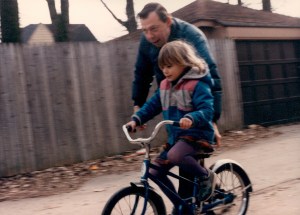
Then I remembered hearing stories about my dad’s pipe. A professor type himself, my father smoked a pipe for many years and only gave up the habit after a triple bypass surgery. I was three years old at the time. Thanks to childhood amnesia, I don’t remember seeing or smelling my father with his pipe. Yet the memory of that smell, and the comfort I once associated it with, have been buried in my brain all these years like lost coins.

In theory, the memory isn’t a positive one. The secondhand smoke my brother and I inhaled early in life may have had something to do with the asthma we developed later in childhood. Still, my reaction to that stranger’s pipe smoke feels positive.  Precious, even. I’d like to think it reflects how I felt in those early years when I sat in my father’s lap or wrapped my fingers around those broad, flat knuckles. Contented and safe. And as a mother, I’d like to think that I’m planting the same warm feelings in my young daughter. Maybe someday after I’m gone an association will unearth them and she can revisit that innocent comfort all over again.
002578cd_scan46_0046

Even after I solved the mystery of the scent I followed the smoking stranger for a couple more blocks, inhaling and even closing my eyes as I experienced something of my father that I never knew I knew. It was hard to turn back for home. I didn’t want to lose him quite yet. I wasn’t ready. But then again no one ever is.

___

Photo credits: Sally Frye Schwarzlose

My Body or Yours?

liztan_bodiespic

Today we’re talking bodies. Not how they look in skinny jeans or whether they can win a Tour de France without steroids. We’re talking about how it feels to have a body of your own, one that is (or seems to be) conveniently connected to your head and neck.

I’ve written about body ownership before in the context of pregnancy. Although I focused on how I dreamt of my body during sleep, I also mentioned that my ballooning physical dimensions affected my coordination. I’d bump into countertops or doorways with my big belly and sometimes struggled to locate my center of gravity. Yet as strange as my new body was, it always felt like it belonged to me. This was an enormous blessing, of course, but it’s somewhat surprising  as well. After all, before my pregnancy I’d lived with the same body since puberty. After more than a decade and a half of experience with that body, I suddenly had to adjust to my new body in a matter of months. Or rather days, because that new body kept growing larger still. Although my belly would feel surreal at times, overall I had remarkably little trouble adjusting to my metamorphosis. The body was still mine in all its lumpy glory.

I was reminded of this experience recently when I came across a scientific paper about body swapping. I know it sounds as if the only science in something called body swapping must come from the term science fiction. Actually, body swapping is a remarkable perceptual illusion that requires nothing more than a second person, a set of head mounted cameras and a set of head mounted displays. Someone facing you wears the cameras mounted on a helmet and you wear the visual displays (which are presented to your two eyes like goggles as part of a virtual reality-style headset). The camera footage, filmed from the visual perspective of the second person, is fed directly into your visual display. Thus, you see your own body from the second person’s perspective.

But we haven’t made it to Freaky Friday just yet. The illusion requires something more. You and the other person take each other’s hands and begin squeezing them simultaneously. Nothing fancy. But in the words of the write up by Valeria Petkova and Henrik Ehrsson, this simple setup alone “. . . evoked a vivid illusion that the experimenter’s arm was the participant’s own arm and that the participants could sense their entire body just behind this arm. Most remarkably, the participants’ sensations of the tactile and muscular stimulation elicited by the squeezing of the hands seemed to originate from the experimenter’s hand, and not from their own clearly visible hand.”

So after a lifetime in your own body, it only takes a video feed and a few hand squeezes for you to make yourself at home in someone else’s arms and legs. If this setup sounds familiar, it is a more impressive incarnation of the classic rubber hand illusion. And a new and remarkable twist on the illusion just appeared in the news: scientists in the same lab have made people feel as if they have an invisible hand. (For a great discussion of this new illusion, read this.)

In science, we tend to think about human perception in general and illusions in particular in terms of adaptations and optimizations. Lots of visual illusions are based on the statistical probability of objects and events in our environment. Our brains learn to predict and extrapolate information about our settings because they jump to the likeliest conclusions. In this way illusions, while technically errors, often reveal clever shortcuts our brain takes to help us understand or parse our surroundings faster, better, or at less of an energy cost.

But what about the body swap? Since we never actually swap bodies, why should we mentally be able to do it? What’s the advantage? Well, the advantage seems to come down to the very fact that we never actually swap bodies. In our ever-changing world, a rare given is that you will have the same body tomorrow that you had today and yesterday. So why should your brain waste precious time or energy soliciting proof from every finger and toe, curve and joint, flex and bend? Take a smidge of visual evidence (in this case, the video display) and a dab of tactile confirmation (hand squeezing) and you have a recipe for body ownership. How often in the natural world would this recipe ever lead you astray?

So in essence you only think that you feel that you own your body. In truth, your brain is creating that sensation on the fly all the time. You could think of it as a philosophical conundrum or cause for an existential crisis. I prefer to think of it as good news for pregnant ladies everywhere.

_____

Photo credit: Elizabeth Tan

ResearchBlogging.org

Petkova VI, & Ehrsson HH (2008). If I Were You: Perceptual Illusion of Body Swapping PLOS One DOI: 10.1371/journal.pone.0003832

The End of History

Intersection 12-12-12 Day 347 G+ 365 Project 12 December 2012I just read a wonderful little article about how we think about ourselves. The paper, which came out in January, opens with a tantalizing paragraph that I simply have to share:

“At every stage of life, people make decisions that profoundly influence the lives of the people they will become—and when they finally become those people, they aren’t always thrilled about it. Young adults pay to remove the tattoos that teenagers paid to get, middle-aged adults rush to divorce the people whom young adults rushed to marry, and older adults visit health spas to lose what middle-aged adults visited restaurants to gain. Why do people so often make decisions that their future selves regret?”

To answer this question, the study’s authors recruited nearly 20,000 participants from the website of “a popular television show.” (I personally think they should have told us which one. I’d imagine there are differences between the people who flock to the websites for Oprah, The Nightly News, or, say, Jersey Shore.)

The study subjects ranged in age from 18 to 68 years of age. For the experiment, they had to fill out an online questionnaire about their current personality, core values, or personal preferences (such as favorite food). Half of the subjects—those in the reporter group—were then asked to report how they would have filled out the questionnaire ten years prior, while the other half—those in the predictor group—were asked to predict how they will fill it out ten years hence. For each subject, the authors computed the difference between the subject’s responses for his current self and those for his reported past self or predicted future self. And here’s the clever part: they could compare participants across ages. For example, they could compare how an 18-year-old’s prediction of his 28-year-old future self differed from a 28-year-old’s report of his 18-year-old self. It sounds crazy, but they did some great follow up studies to make sure the comparison was valid.

The results show a remarkable pattern. People believe that they have changed considerably in the past, even while they expect to change little in the future. And while they tend to be pretty accurate in their assessment of how much they’ve changed in years passed, they are grossly underestimating how much they will change in the coming years. The authors call this effect The End of History Illusion. And it’s not just found in shortsighted teenagers or twenty-somethings. While the study showed that older people do change less than younger people, they still underestimate how much they will continue to change in the decade to come.

The End of History Illusion is interesting in its own right. Why are we so illogical when reasoning about ourselves – and particularly, our own minds? We all understand that we will change physically as we age, both in how well our bodies function and how they look to others. Yet we deny the continued evolution (or devolution) of our traits, values, and preferences. We live each day as though we have finally achieved our ultimate selves. It is, in some ways, a depressing outlook. As much as we may like ourselves now, wouldn’t it be more heartening to believe that we will keep growing and improving as human beings?

The End of History Illusion also comes with a cost. We are constantly making flawed decisions for our future selves. As the paper’s opening paragraph illustrated, we take actions today under the assumption that our future desires and needs won’t change. In a follow up study, the authors even demonstrate this effect by showing that people would be willing to pay an average of $129 now to see a concert by their favorite band in ten years, while they would only be willing to pay an average of $80 now to see a concert by their favorite band from ten years back. Here, the illusion will only cost us money. In real life, it could cost us our health, our families, our future well-being.

This study reminded me of a book I read a while back called Stumbling on Happiness (written, it turns out, by the second author on this paper). The book’s central thesis is that we are bad at predicting what will make us happy and the whole thing is written in the delightful style of this paper’s opening paragraph. For those of you with the time, it’s worth a read. For those of you without time, I can only hope you’ll have more time in the future. With any luck we’ll all have more – more insight, more compassion, more happiness—in the decade to come.

____

Photo credit: Darla Hueske

ResearchBlogging.org

Quoidbach J, Gilbert DT, & Wilson TD (2013). TheEnd of History Illusion Science DOI: 10.1126/science.1229294

Feeling Invisible Light

7401773382_19963f6a8b_cIn my last post, I wrote about whether we can imagine experiencing a sense that we don’t possess (such as a trout’s sense of magnetic fields). Since then a study has come out that adds a new twist to our little thought experiment. And for that we can thank six trailblazing rats in North Carolina.

Like us, rats see only a sliver of the full electromagnetic spectrum. They can perceive red light with wavelengths as long as about 650 nanometers, but radiation with longer wavelengths (known as infrared, or IR, radiation) is invisible to them. Or it was before a group of researchers at Duke began their experiment. They first trained the rats to indicate with a nose poke where they saw a visible light turned on. Then the researchers mounted an IR detector to each rat’s head and surgically implanted tiny electrodes into the part of its brain that processes tactile sensations from its whiskers.

After these sci-fi surgeries, each rat was trained to do the same light detection task again – only this time it had to detect infrared instead of visible light. Whenever the IR detectors on the animal’s head picked up IR radiation, the electrodes stimulated the tactile whisker-responsive area of its brain. So while the rat’s eyes could not detect the IR lights, a part of its brain was still receiving information about them.

Could they do the new task? Not very well at first. But within a month, these adult rats learned to do the IR detection task quite well. They even developed new strategies to accomplish their new task; as these videos show, they learned to sweep their heads back and forth to detect and localize the infrared sources.

Overall, this study shows us that the adult brain is capable of acquiring a new or expanded sense. But it doesn’t tell us how the rats experienced this new sense. Two details from the study suggest that the rats experienced IR radiation as a tactile sensation. First, the post-surgical rats scratched at their faces when first exposed to IR radiation, just as they might if they initially interpreted the IR-related brain activity as something brushing against their whiskers. Second, when the scientists studied the activity of the touch neurons receiving IR-linked stimulation after extensive IR training, they found that the majority responded to both touch and infrared light. At least to some degree, the senses of touch and of infrared vision were integrated within the individual neurons themselves.

In my last post, I found that I was only able to imagine magnetosensation by analogy to my sense of touch. Using some fancy technology, the scientists at Duke were able to turn this exercise in imagination into a reality. The rats were truly able to experience a new sense by piggybacking on an existing sense. The findings demonstrate the remarkable plasticity of the adult brain – a comforting thought as we all barrel toward our later years – but they also provide us with a glimpse of future possibilities. Someday we might be able to follow up on our thought experiment with an actual experiment. With a little brain surgery, we may someday be able to ‘see’ infrared or ultraviolet light. Or we might just hook ourselves up to a magnificent compass and have a taste (or feel or smell or sight or sound) of magnetosensation after all.

____

Photo credit: Novartis AG

ResearchBlogging.org

Thomson EE, Carra R, & Nicolelis MA (2013). Perceiving invisible light through a somatosensory cortical prosthesis. Nature communications, 4 PMID: 23403583

Be the Trout

1448187231_be85e17541_bMost of the time I forget that my mother lacks a sense of smell. It’s only when I complain about something stinky or comment on a delicious smell that I remember she isn’t sharing the experience with me. As I’ve mentioned before, my mother has never had a sense of smell, or at least none that she can ever remember. As a child, I often wondered how she might imagine the sensation of smell. Would she do it by analogy to her other senses? Would she be able to do it at all?

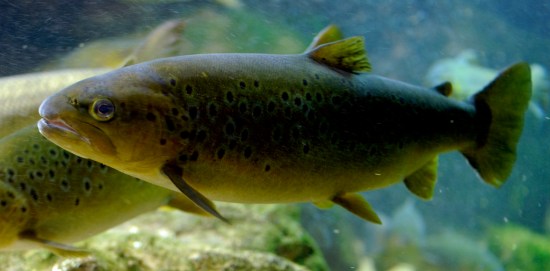
I returned to these musings from a different perspective recently when I read a scientific paper about trout. Trout, along with other migratory species from salmon to sea turtles and certain types of birds, enjoy a sense that we lack: magnetosensation. These animals perceive magnetic fields (including that of the Earth) and can use this information to orient themselves and navigate. The study’s authors found magnetic cells inside the noses of trout, each with tiny iron-containing crystals attached to their cell membranes. Thus, when a trout changed direction relative to the Earth’s magnetic field, these miniature magnets would presumably tug on the cell’s membrane in a way that the cell could detect and signal to other parts of the trout’s nervous system. The evolution of these wonderful little biological compasses may have been necessary for migrating animals to evolve on our planet and happily roam, return, and repeat.

So today I put myself in my mother’s shoes (or nose) and tried to imagine a sense I didn’t have. What would it be like to feel magnetic fields? I tried to embrace the role and be the trout. I closed my eyes and imagined my little trout self swimming around within a magnetic field that changed as I moved. How would that feel for the trout? My imaginative efforts were rewarded with a strong percept – flashes of tingling across the surface of my skin that mirrored my changes in direction. In essence, I could only imagine magnetosensation by analogy to somatosensation, the sense of touch. And this is almost certainly not what magnetosensation feels like to a trout. Not only do they already have a sense of touch akin to our own, but they also detect magnetic fields with their snout rather than their whole body.

It makes sense that I imagined a foreign sensation by analogy to one I know. Each of our senses has dedicated processing areas in the brain. Without a brain area developed for magnetosensation, it may not be possible to do any better than imagine it by way of the senses our brain can process. Or maybe it’s possible for people with more imaginative imaginations than my own. If you give it a try, please let me know what you come up with! And the next time you find yourself staring down a trout, tilapia, tuna, or salmon on your plate, spare a moment to appreciate that it has experienced a realm of sensations beyond your imagination. And then – bon appétit!

___

Photo credit: sharkbait

ResearchBlogging.org

Eder SHK, Cadiou H, Muhamad A, McNaughton PA, Kirschvink JL, & Winklhofer M (2012). Magnetic characterization of isolated candidate vertebrate magnetoreceptor cells PNAS DOI: 10.1073/pnas.1205653109